
How a Man-Eating Shark Filled a Church
by James RayThe famous author of “No One Ever Cared for Me Like Jesus” on occasions led singing for Billy Sunday. He related to me of hearing D. L. Moody. Once he met William Jennings Bryan on a train.
As a young student, my wife, Mary, was assigned at Bible college to keep his room ready. Tennessee Temple University had built a special apartment for him at the school. The president of the school at the time, Dr. Lee Roberson, felt that the presence of such a man on campus would be a positive influence on the students.
Mary often would hear the great man writing songs, singing, and playing the piano. He would call her into the music room and sing his new songs to her. One of our treasured possessions is a letter written to us on the occasion of our wedding when the great man was 92 years old.
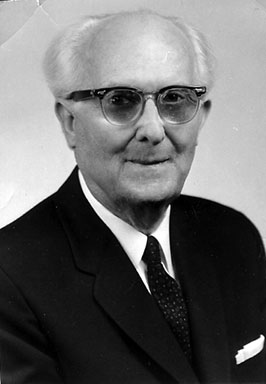 When Charles Weigle came to our church for special meetings, I listened intently to the stories and events of an era long gone. There was the citywide meeting in an Ohio city. Billy Sunday and other friends urged Charles to abandon the plans for the meeting. “That town is a preacher’s graveyard,” they told him. Still determined that God was in it, Charles Weigle proceeded. He remembered, “We built a huge tin tabernacle. I preached my heart out for two weeks. Then I gave an invitation and 2,000 people responded receiving Christ.”
Most unforgettable was the account of the shark that filled a church. “I was preaching a meeting in California. On Monday night the meeting was almost bare with few people attending. That night in my room I knelt and prayed about the matter. I reminded the Lord that empty pews could not repent and believe. I asked God to fill the church.
Had I known how God would answer that prayer, I would not have prayed it. The next morning a member of the church who owned a house on the seashore invited me to come and swim from his private beach.
There I was, out in the ocean enjoying the waves, when suddenly something beneath the water brushed against my legs. Without thinking, I reacted and grabbed the object. Immediately I realized that it was ALIVE—in fact it was a man-eating shark! I was afraid to let go. The big fish seemed angry. When it pulled one way, I pulled it the other from left to right. We were making quite a big splash. Panic stricken, I began working toward shore.
As we wrestled, the shark and I, a great crowd of people gathered, watching in amazement. After a very fatiguing struggle, I was able to drag the big fish onto the sand. A man from the watching crowd stabbed the shark to death with a pocketknife.
I staggered a few feet away and collapsed on the sand completely out of breath. In God’s providence a reporter was passing by the area and noticed the great crowd gathered on the beach. Thinking someone must have drowned, he stopped his car to investigate. A bystander informed him that the man lying on the sand had brought in the man-eating shark with his bare hands.
The reporter stood over me and asked, ‘Sir, is it true that you brought this shark in with your bare hands?’ I told him, ‘Yes, it is true.’ He said, ‘That has never happened on this shore before.’ I told him, ‘As far as I am concerned—it will never happen again!’”
Taking notes, the reporter recorded all the facts concerning his ministry, the special meetings, and the services and then took his picture. The next morning that newspaper that circulated throughout the main towns and communities along the coast carried the story of the evangelist who brought in a man-eating shark with his bare hands. His picture and the event were featured on the front page. That night the church was packed with people who had come to see the man they had read about in the newspaper. The Lord answered his prayer and filled the church—but in a very surprising way.
Some time ago while spending a night in Lafayette, Indiana, I remembered an event Charles Weigle had related to me—an event that had occurred in his childhood. “When I was a boy, our family lived in Lafayette, Indiana, near the old Wabash River. I was down under the old wooden City Bridge playing with some matches. After a while, the trash caught fire and was out of control in no time at all. Worst still the wooden poles and beams of the bridge were soon on fire. I ran home and hid in a small shed behind our house. Soon I heard the sound of sirens and firewagons. I asked my father what the noise was and he told me that someone had set the City Bridge on fire. I asked, ‘What will they do to the person who did that?’ He replied that they would lock him up in jail. ‘What if it were a little boy?’ My father said, ‘They would lock him up too.’ The entire bridge burnt down.”
Years later Charles Weigle, then a well-known evangelist, held a meeting in Lafayette, Indiana. He found his way to the police station and told them that when he was a lad in the town that he was the one who burnt down the City Bridge. The police laughed and said, “Well, we needed a new bridge anyhow.” Charles Weigle wrote many songs, which were published and sold widely. His most famous song was “No One Ever Cared For Me Like Jesus.” With still a note of sadness in his voice, he explained how his first wife forsook him, betraying their marriage vows. After he had watched her and his daughter pull away on the train, he walked out on a pier extending out a ways into the ocean.
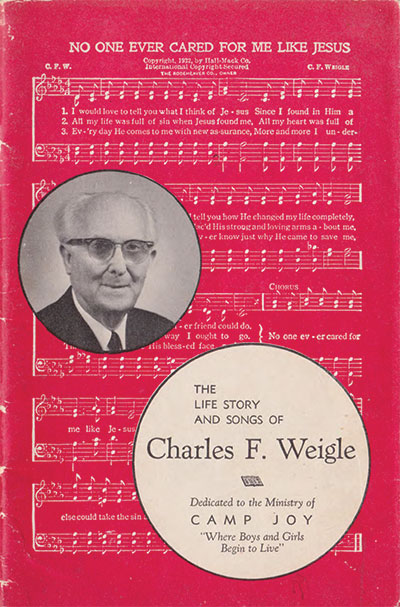 “I could hear the devil whisper, ‘Weigle—jump into the water and all of your troubles will be over. End it all.’ After a moment of consideration I stepped back from the edge of the pier and said, ‘Satan, you’re a liar.’” In that moment, God put something into his heart. Later, alone, forsaken, he wrote “No One Ever Cared For Me Like Jesus.”
At 92 years of age, he told this writer that an estimated 20,000 people had come to Christ as a result of that song alone. Illustrating, he recounted: “In Chicago the newspapers carried the story of a man who worked in a lunchroom. After being reprimanded, he returned to his place of work and killed a man. He was tried and sentenced to die in the electric chair.
Some Christians visited the man and led him to Christ. There was such a change in the man that everyone believed him to be sincere and truly converted. Intercession was made for him, but there was no reprieve. Again the papers carried the story. The condemned man walked the last mile to the electric chair singing . . . “No One Ever Cared For Me Like Jesus.”
When the Communist regime fell in Romania, our mission organization set up various ministries in the country. Deep in the heart of Romania, we attended a Romanian church and heard a young woman sing in her native language “No One Ever Cared For Me Like Jesus.” The song had pierced even the iron borders of communism.
Charles Weigle was 92 when he preached for us in our church. On the last night, he preached on the title “A Trip to Heaven and Back.” The sermon lasted over one hour and a half. The congregation sat at rapt attention almost spellbound.
Some months later when word came to me of his death, I remembered his last words to me when I said goodbye at the airport: “James, one of these days you will get the word—Old Weigle is gone. I just want you to know I will be in Heaven.” His wonderful life had influenced thousands. His personal sorrows had only served to sweeten his spirit and to make him strength for others.
“I sing of Thee, and smile thro’ tears
When sorrow comes to make me sad;
For I remember thro’ the years
Thy grace, and sing because I’m glad.
I sing of Thee, O blessed Saviour,
Thy praise shall now my tongue employ;
I sing of Thee, O Lord, forever,
For Thou has filled my soul with joy.”
Charles F. Weigle
 Next Article
 Dr. James Ray