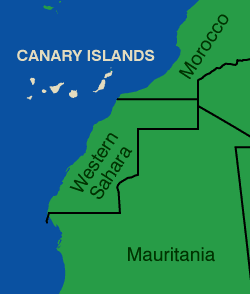
The Canary Islands is a group of eight main volcanic islands—the visible part of submarine mountains. Politically, they are part of Europe, being an autonomous community of Spain, but, geographically, they are part of Africa...only a hundred kilometers away from Morocco.
Their recorded history goes farther back than that of most African countries: they were visited by Phoenician and ancient Greek sailors, and were written of by Roman historians. In modern ages, the islands' geographic position made them a convenient stop for ships en route to the Americas, bringing Spanish galleons, conquistadors, and merchantmen frequently to their shores. The various cargos and peoples continuously passing through in years past have produced an eclectic society today. Over two-million inhabitants, many from South America as well as from Europe and Africa are found on these populous islands. They have two capital cities on separate islands, and over 80% of the population can be found on these two islands. The population is additionally diversified with millions of tourists every year.
Although the citizens are largely unified under one language—their own dialect of Spanish—each migrant society brought their own religion with them. While most people claim Catholicism, there are many religions and cults that can be found in these islands, including a neo-pagan religion unique to the Canary Islands. It doesn’t take a long visit to see that this friendly, peaceful country is home to much religious confusion, while some refuse to believe in any form of religion, claiming atheism as their world view.
 Eric & Lori Bohman
Read more about the Bohmans.
He may be contacted through the BIMI office: (423) 344-5050.
 Angola
 Benin
Benin Botswana
 Burkina Faso
 Burundi
 Cameroon
 Canary Islands
 Cape Verde
 Central African Republic
 Chad
Chad Comoros
 Democratic Republic of Congo
 Djibouti
 Egypt
Egypt Equatorial Guinea
 Eritrea
 Eswatini
 Ethiopia
 Gabon
Gabon Ghana
Ghana Guinea
 Guinea-Bissau
 Ivory Coast (Côte d'Ivoire)
 Kenya
Kenya Lesotho
 Liberia
 Madagascar
 Malawi
 Mali
Mali Mauritania
 Mauritius
 Morocco
 Mozambique
 Namibia
 Niger
Niger Nigeria
 Republic of Congo
 Rwanda
 São Tomé & Príncipe
 Senegal
 Seychelles
 Sierra Leone
 Somalia
 South Africa
 South Sudan
 Sudan
Sudan Tanzania
 The Gambia
 Togo
Togo Tunisia
 Uganda
 Zambia
 Zimbabwe