Many Liberians trace their descendants from tribes once a part of the Mali or Songhi empires. Others trace it to a migration in the 1800’s mostly from the US and Caribbean made up, largely, of freed slaves. Thousands of immigrants flocked to this tropical country approximately the size of Virginia. In 1847, Liberia was the first country in Africa to declare independence, which gives it the distinction of being the first modern republic in Africa. For many years, its government was predominately stable and democratic; its economy grew greatly, and it played a part on the international scene.
In 1980, however, the country took a dramatic turn after a coup. For five years, the country was under military rule. The next five years was under civilian rule preceding two civil wars, in which approximately 8% of its population was killed. Many fled the country during these years, and the country was devastated. Peace was finally achieved in 2003.
The country is still recovering from the effects of those turbulent years. Although over half of its over five million people live in urban areas, many of them being outside the capital, it is estimated that only 15% are considered to be formally employed. Less than half are literate. Corruption is wide-spread and acknowledged to be the country’s "major public enemy." However, the situation is improving: currently only 50% of the population is below the poverty line in contrast to the over 80% back in 2015. English is the official language, although the majority of the population currently speaks one of several dialects. While Liberia’s need can be seen in nearly every area, its most pressing need is spiritual. Although Christianity is claimed by over 80%, very few are truly saved or have the means of hearing the Truth. The "Christianity" so prevalent there is a largely mixture of error and superstition with very few Gospel churches to "hold forth the Word of life."
 Liberia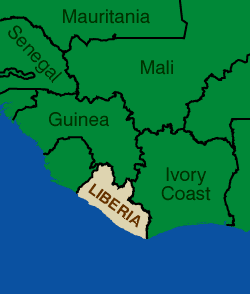
 Eric & Lori Bohman
 Angola
 Benin
Benin Botswana
 Burkina Faso
 Burundi
 Cameroon
 Canary Islands
 Cape Verde
 Central African Republic
 Chad
Chad Comoros
 Democratic Republic of Congo
 Djibouti
 Egypt
Egypt Equatorial Guinea
 Eritrea
 Eswatini
 Ethiopia
 Gabon
Gabon Ghana
Ghana Guinea
 Guinea-Bissau
 Ivory Coast (Côte d'Ivoire)
 Kenya
Kenya Lesotho
 Madagascar
 Malawi
 Mali
Mali Mauritania
 Mauritius
 Morocco
 Mozambique
 Namibia
 Niger
Niger Nigeria
 Republic of Congo
 Rwanda
 São Tomé & Príncipe
 Senegal
 Seychelles
 Sierra Leone
 Somalia
 South Africa
 South Sudan
 Sudan
Sudan Tanzania
 The Gambia
 Togo
Togo Tunisia
 Uganda
 Zambia
 Zimbabwe